

Shipping Fine Art to the US? Understanding CBP Form 5106 to Avoid Customs Delays
Shipping artwork, antiques, or other valuable pieces to the United States involves navigating specific U.S. customs regulations. We’ve noticed some galleries, artists, and collectors experiencing delays related to a specific document: CBP Form 5106.
What is CBP Form 5106?
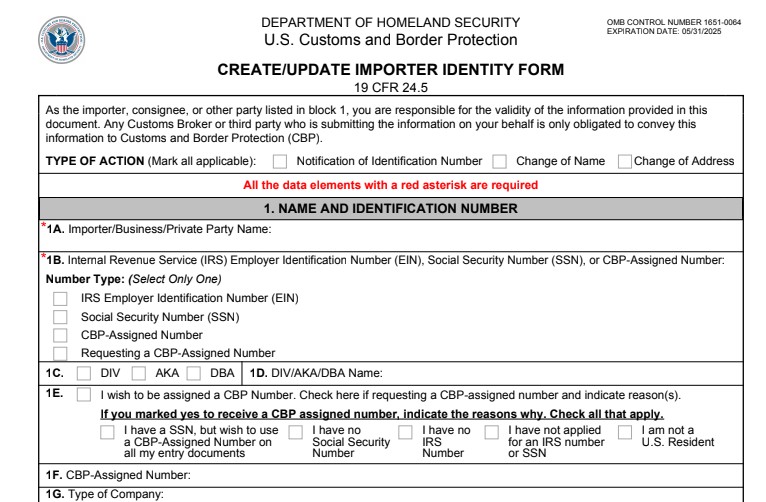
Form 5106 is an official document from U.S. Customs and Border Protection (CBP). Its primary purpose is to create or update the recipient’s identity in the U.S. customs records.
This is not a tax, but a one-time registration formality. CBP uses it to assign a unique identification number (known officially as the “Importer of Record” or IOR, which in this case is the recipient) to every person or business receiving high-value goods.
(Source: U.S. Customs and Border Protection – CBP Form 5106 FAQ)
When is this Form Necessary?
To keep it simple, CBP Form 5106 is generally required if your shipment meets these conditions:
- The artwork’s value is over $2,500 USD: This threshold triggers a “formal entry” for U.S. Customs. (Shipments valued under this amount are usually processed as “informal entries” and do not require this form).
- The recipient is NOT registered with U.S. Customs: If this is the recipient’s first time receiving a high-value shipment from abroad, they must complete Form 5106 to register.
- The recipient’s information has changed: If the recipient is already registered but has recently changed their legal name, address, or tax identification number, a new form must be submitted to update their CBP file.
The Crucial Point: Who Must Fill Out This Form?
This is where delays happen: Form 5106 must be completed and signed by the recipient in the U.S., not by the shipper. Neither the sender (the gallery or artist) nor the carrier (FedEx, DHL, etc.) can legally fill out or submit this information on their behalf. The reason is simple: this form requests sensitive tax identification information (like an SSN or EIN) that only the recipient can legally provide.
Our Advice for a Smooth Art Delivery
Customs clearance is a team effort. To avoid having a valuable piece of art held at the border, both parties need to be proactive:
- For Senders (Galleries & Artists) – Plan Ahead: If you are shipping an artwork valued over $2,500 to a new buyer in the U.S., inform them in advance. Let them know they will likely need to fill out a standard customs form (Form 5106) and will need their SSN (for individuals) or EIN (for businesses) handy. Setting expectations early prevents surprises.
- For Recipients (Collectors & Buyers) – Be Responsive: The carrier (FedEx, DHL, etc.) will contact you directly via email or phone when the artwork reaches the border. It is essential to respond quickly and provide the completed form so customs clearance can proceed without delaying your delivery.
Why Moviiu is Your Best Partner for Fine Art Transportation
Shipping fine art internationally requires more than just custom crates and careful handling; it demands deep expertise in global customs procedures.
At Moviiu, we specialize in the secure transportation of artwork. We understand that paperwork like CBP Form 5106 can seem daunting. That’s why our team proactively monitors your shipments, anticipating customs requirements before they become bottlenecks. We guide our senders on the right documentation to prepare and ensure recipients understand exactly what is expected of them. With Moviiu, you get peace of mind knowing your valuable pieces are managed by art logistics experts from pick-up to final delivery.
The Moviiu Advantage – Anticipate & Automate
To make this process completely seamless, you can use the Moviiu platform to get ahead of customs! If the recipient is already registered, you can securely provide their SSN or EIN directly through our system in advance. Alternatively, you can upload the pre-filled CBP Form 5106 as an attachment when booking your shipment. We will automatically include it in the official customs paperwork, bypassing the carrier’s waiting period and ensuring the smoothest possible border crossing for your artwork.
Need secure art transport?
Step-by-Step Guide: Filling Out Form 5106
When the carrier contacts the recipient, they will provide a link to an online portal or a PDF form. While it may look long, it follows a clear logic. Here are the key steps:
Step 1: Determine Your Type of Action
This is the first section. You must state the reason for your submission.
- Notification of Identification Number: This is the most common choice. Select this if it’s your first time importing a shipment of this value or if your importer number is inactive.
- Name Change / Address Change: Only use this if you are already registered and are updating your information.
Step 2: Provide Your Name and Identification Information
This is the most important section for identifying you.
- 1A (Full Legal Name): Enter your full legal name (if you are an individual) or the exact legal name of your company.
- Your Identification Number (Boxes 1B, 1E, 1F): This is the key part, read carefully.
- If you are a U.S. Business: Enter your EIN (Employer Identification Number) in box 1B.
- If you are a U.S. Individual: Enter your SSN (Social Security Number) in box 1B.
- If you already have a CBP Number: If you already have a “CBP-Assigned Number” and are just making an update (like an address change), enter it in box 1F.
- If you have NEITHER an EIN nor an SSN (e.g., you are a non-resident importer): Check “Requesting a CBP-Assigned Number ” in box 1B and check box 1E (Request a CBP Number). CBP will then assign you a number.
- 1C/1D (Division/AKA/DBA): If your business operates under another name (“Doing Business As”) or is a division of another company, list it here. (This is for businesses). Leave blank as an individual
- 1G (Type of Company): Select the option that best describes your structure (e.g., Individual, Corporation, LLC). Leave blank as an individual
- 1H (Estimated Imports): Provide an estimate of the number of shipments you plan to import into the U.S. per year.
- 1I (Role): Check the box describing your role. For receiving a shipment, you are the Importer of Record.
- 1J-1M (CBP Partnership Programs): If your company participates in special customs partnership programs (like C-TPAT or ISA), enter the codes here. (Otherwise, leave blank). Leave blank as an individual
Step 3: Enter Your Address Information
This section is simple but essential for communication.
- 2A (Mailing Address): Fill in the address where you want to receive official correspondence from CBP.
- You can use a P.O. Box for this address.
- Include the Street, City, State/Province, and Zip/Postal Code.
- The “Country ISO Code” is only required for foreign addresses.
- 2B (Physical Location): Fill this out only if your physical home or business address is different from your mailing address in 2A.
- Important: This address cannot be a P.O. Box.
- 2C-2F (Contact Information): Provide your phone number, fax number (if applicable), email address, and website. The phone and email are critical for the carrier to contact you quickly.
Step 4: Provide Detailed Company Information
Important Note: This section is almost exclusively for business entities (Corporations, LLCs, etc.). If you are an individual receiving a personal shipment, most of these fields will not apply to you.
- 3A (Business Description): Briefly write a description of what your business does.
- 3B, 3C, 3D (Identification Codes – If Applicable):
- 3B (NAICS Code): If you know it, provide your North American Industry Classification System (NAICS) code.
- 3C (Dun & Bradstreet): If available, provide your Dun & Bradstreet (D-U-N-S) Number.
- 3D (Filer Code): If you are a self-filer or broker using your own filer code, enter it here. Otherwise, leave blank.
- 3E, 3H, 3I (Business Registration Details):
- 3E (Year Established): Indicate the year your company was established.
- 3H-3I (Articles of Incorporation): Provide the state or country where your business is incorporated and the unique identifying number from your certificate.
- 3F, 3G (Structural & Financial Information):
- 3F (Related Businesses): List the names and identification numbers of any related businesses (e.g., a parent company).
- 3G (Banking Information): Provide the primary banking information for your company.
- 3J (Company Officers): List the beneficial owners or company officers.
Crucial: If you checked box 1E to request a “CBP-Assigned Number” (because you have no EIN/SSN), you must include the SSN or passport information for the officers listed here.
Step 5: Sign!
Once you have reviewed and signed the form, return it to the carrier (usually via a secure online link or by email). Tip: Always include your tracking number so they can link the form to your artwork immediately!
Here is what you can expect after submitting:
- Processing Time: The carrier will submit your form to U.S. Customs. CBP typically processes new registrations within 1 to 2 business days.
- Notifications: You won’t receive a confirmation email from Customs. Simply keep an eye on your tracking link! The status will automatically update from “Clearance Delay” to “Released.” The carrier will only contact you again if there is an error or if duties need to be paid.
- Delivery: Once customs officially releases the shipment, your artwork will usually be delivered to your door within 1 to 3 business days.